Boat LiFePO4 house battery retrofit
Replace the house battery with LiFePO4, retain a lead-acid starter battery and charge through a current-limited DC–DC charger.
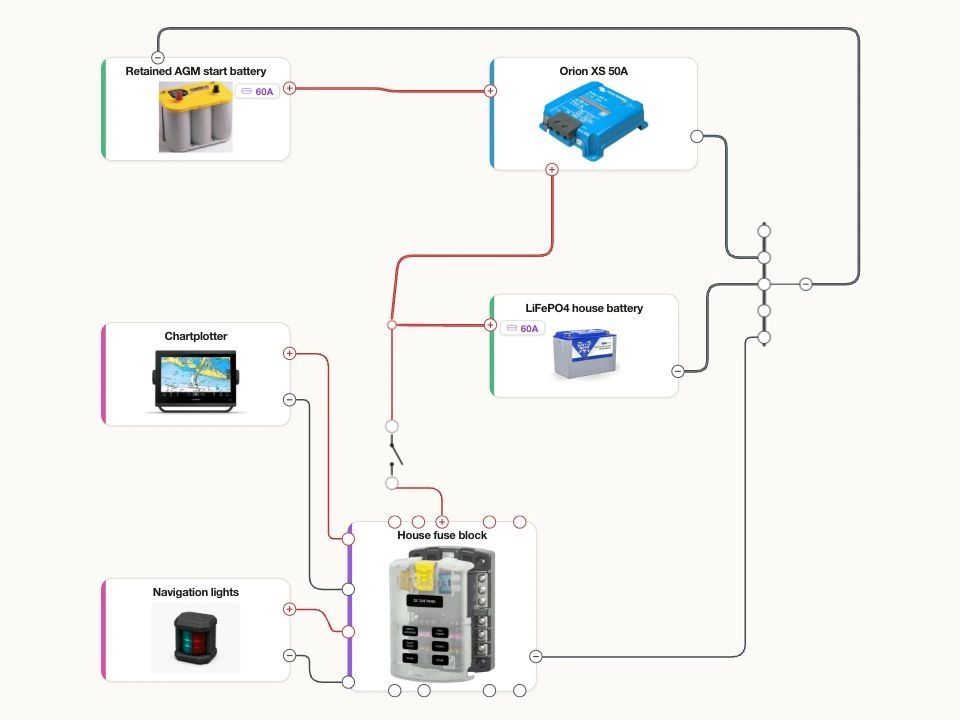
Follow the circuit
01
Keep the starter and house banks separate
The retained lead-acid battery supplies the Orion XS, which charges the LiFePO4 house battery. Remove any old ACR, VSR or Both-switch path that directly joins their positives. The engine and its existing charging circuit are outside this drawing.
02
Set the charging limits
The BB10012 has an internal BMS and a 50 A charge limit. Set the Orion's input limit to the alternator's measured spare hot-idle capacity, and keep total charging from every source within the battery limit. Follow the battery's charge profile, disable equalization and temperature compensation, and prevent charging below 0°C.
03
Switch the loads while keeping charging connected
The charger joins the protected house supply before the house load switch. Switching off the chartplotter and lights therefore leaves charging available. The 60 A battery fuses protect the charging paths; a 15 A feeder fuse and smaller branch fuses protect the house circuits. The 50 A charger bypasses the fuse block's 30 A branch slots.
The source and this example
Victron's Orion XS installation diagram provides the two-battery charging path; Battle Born's BB10012 manual supplies the lithium battery's limits and charging requirements.
We combine those requirements with a compact Blue Sea 5025 fuse block, a house load switch and two example loads. Engine wiring, shore and solar chargers, emergency bank combining and inverter loads are outside this drawing. Cable lengths are example assumptions.
- Battle Born: BB10012 battery manual ↗
Document served as Rev038: battery limits, incompatible battery types, charging profile and cold-temperature protection. Follow the revision supplied with your battery.
- Victron: Orion XS installation ↗
Sections 3.3 and 3.8: 60–70 A external protection, conductor sizes and charger wiring.
- Victron: Orion XS configuration ↗
Engine detection and separate input/output current limits.
- Blue Sea: ST Blade fuse blocks ↗
5025: six circuits with negative bus, 100 A total and 30 A per branch.
- Blue Sea: 60 A MRBF terminal fuse ↗
Requires a compatible holder. Check the published DC interrupt rating against the actual battery fault current.
- Optima: battery application guidance ↗
The photographed D34 YellowTop represents a retained dual-purpose AGM starting supply; engine suitability must be checked separately.
Before you build
- Verify the retained starter battery and engine charging arrangement against the engine requirements; this is a house-bank conversion.
- Commission engine-running detection and both Orion current limits before connecting its output; check any retained shore or solar charger separately.
- The example uses short 16 mm² charging conductors and 60 A MRBF protection. Recheck measured lengths, installation conditions, fuse holders, DC ratings and interrupt capacity for the actual bank. An internal BMS does not replace cable protection.
- The chartplotter and navigation lights are generic loads. Match their current and branch fuses to the installed equipment manuals.
This is a planning example. Cable sizing uses Crimp’s ABYC-based method; the drawing does not certify an installation.
Cable sizes and connections · 13 conductors
Lengths are one way. Sizes and currents come from the same Crimp model as the drawing. Each drop value covers one drawn conductor; the full circuit includes its supply and return. AWG values are approximate counterparts to the metric areas.
| Connection | Length | Wire | Design current | Fuse | Drop |
|---|---|---|---|---|---|
| C1 · Retained AGM start battery + → Victron Orion XS 12/12-50 IN + | 2 m | 16 mm²AWG 6 | 50 A | — | 0.91% |
| C2 · Retained AGM start battery − → Common negative − | 1.6 m | 16 mm²AWG 6 | 50 A | — | 0.73% |
| C3 · Victron Orion XS 12/12-50 OUT + → Fused house supply | 65 cm | 16 mm²AWG 6 | 50 A | — | 0.28% |
| C4 · LiFePO4 house battery + → Fused house supply | 15 cm | 16 mm²AWG 6 | 50 A | — | 0.06% |
| C5 · Victron Orion XS 12/12-50 GND − → Common negative 4 − | 40 cm | 16 mm²AWG 6 | 0 A | — | 0.00% |
| C6 · LiFePO4 house battery − → Common negative 3 − | 40 cm | 16 mm²AWG 6 | 50 A | — | 0.17% |
| C7 · Fused house supply → House load switch A | 20 cm | 1.5 mm²AWG 16 | 3.7 A | 15 A | 0.07% |
| C8 · House load switch B → House fuse block IN + | 30 cm | 1.5 mm²AWG 16 | 3.7 A | — | 0.10% |
| C9 · House fuse block IN − → Common negative 1 − | 50 cm | 1.5 mm²AWG 16 | 3.7 A | — | 0.17% |
| C10 · House fuse block 1 + → Chartplotter + | 2 m | 1.5 mm²AWG 16 | 3.2 A | 7.5 A | 0.58% |
| C11 · Chartplotter − → House fuse block 1 − | 2 m | 1.5 mm²AWG 16 | 3.2 A | — | 0.58% |
| C12 · House fuse block 4 + → Navigation lights + | 3 m | 1.5 mm²AWG 16 | 0.5 A | 3 A | 0.14% |
| C13 · Navigation lights − → House fuse block 4 − | 3 m | 1.5 mm²AWG 16 | 0.5 A | — | 0.14% |
A dash means no fuse is assigned to that conductor; upstream protection may apply. Recheck the exact device, holder and placement after edits.
Equipment · 9 components
- Retained AGM start battery
12 V · 55 Ah
The photographed Optima D34 represents a retained AGM starting supply. Engine, alternator, starter cables and their isolation are outside this subsystem. Check the existing battery against the engine requirements. This 60 A fuse protects only the added DC-DC charging branch, not a starter-motor cable.
- Victron Orion XS 12/12-50
50 A rated / planning output
The Orion XS is shown with its three physical IN, OUT and GND connections. One 16 mm² GND wire connects it to the common battery-negative bus. The drawing sizes for its full 50 A limits. Set input current to the alternator's measured spare hot-idle capacity and output current no higher than the battery's 50 A charge limit. Configure engine detection and the battery's lithium profile before use; do not retain a parallel ACR/VSR/Both connection to the lithium bank.
- LiFePO4 house battery
12.8 V · 100 Ah
Battle Born BB10012, 100 Ah, with integrated BMS. Its manual specifies 50 A maximum charging and 100 A continuous discharge. The BMS does not replace external cable protection. Use the battery's approved lithium profile, disable equalization and temperature compensation, and prevent charging below 0°C. The 60 A MRBF is a Crimp-selected cable-protection adaptation, installed in a compatible terminal fuse holder. Prospective battery fault current and suitability of the exact fuse's interrupt rating remain to be verified.
- Fused house supply
A wire splice — any number of cables can meet here. Born from a cable dropped into empty space; promotes to a real junction once a second cable lands on it.
- House load switch
Single-circuit ON/OFF battery switch. 300 A continuous, 500 A intermittent (5 min), 900 A cranking (30 s); 3/8-inch-16 tin-plated copper studs. Ignition protected.
- House fuse block
Blue Sea 5025 six-circuit ST Blade block, rated 100 A total and 30 A per circuit. Only the house loads pass through its ATC slots. The 50 A charger connects before the house load switch and bypasses the branch fuse slots.
- Chartplotter
3.2 A load allowance
Generic example load; replace its draw and branch fuse with the actual equipment manual's values.
- Navigation lights
0.5 A load allowance · 6 W
Generic example load; replace its draw and branch fuse with the actual equipment manual's values.
- Common negative
Negative bus bar — common return with multiple output studs.
Crimp checks · 2 findings to review
These are the current engine findings for the saved example. They remain visible when you open it in Crimp.
- warning: Check fuse suitability: LiFePO4 house battery
- warning: Check fuse suitability: Retained AGM start battery
More boat examples
View all 6 →Bilge pump with an always-on supply
Keep the automatic bilge circuit powered when you switch off the rest of the boat.
Boat solar charging for a house battery
Follow a solar panel through its controller to a house battery, chartplotter and navigation lights.
12V trolling motor with a separate battery
Give the trolling motor its own battery and keep the chartplotter on a separate supply.
Shore charging for two boat batteries
Use separate charger outputs to replenish two batteries without joining their positive terminals.
Boat dual battery selector switch
See how a 1–2–Both switch feeds the same boat circuits from either battery.
Crimp for AI agents · public beta
Ask your AI. Check the plan in Crimp.
Connect ChatGPT, Codex or Claude Code to look up components, calculate wire and DC-DC charger sizing, or build a small draft you can inspect and edit. Missing facts and assumptions stay visible.
No Crimp account or API key required.