Black Week: 30% off Lifetime and Pro. Ends Sunday.

Solar wiring guide

Solar panels in series vs parallel: which is better?

Series adds the panels' voltages, parallel adds their currents. Which is better depends on three things you can check: your charge controller's limits, how much shade falls on the roof, and how far the cable runs to the controller.

Checked Nov 27, 2026 · 12 V and 24 V solar with an MPPT or PWM controller · your manual wins

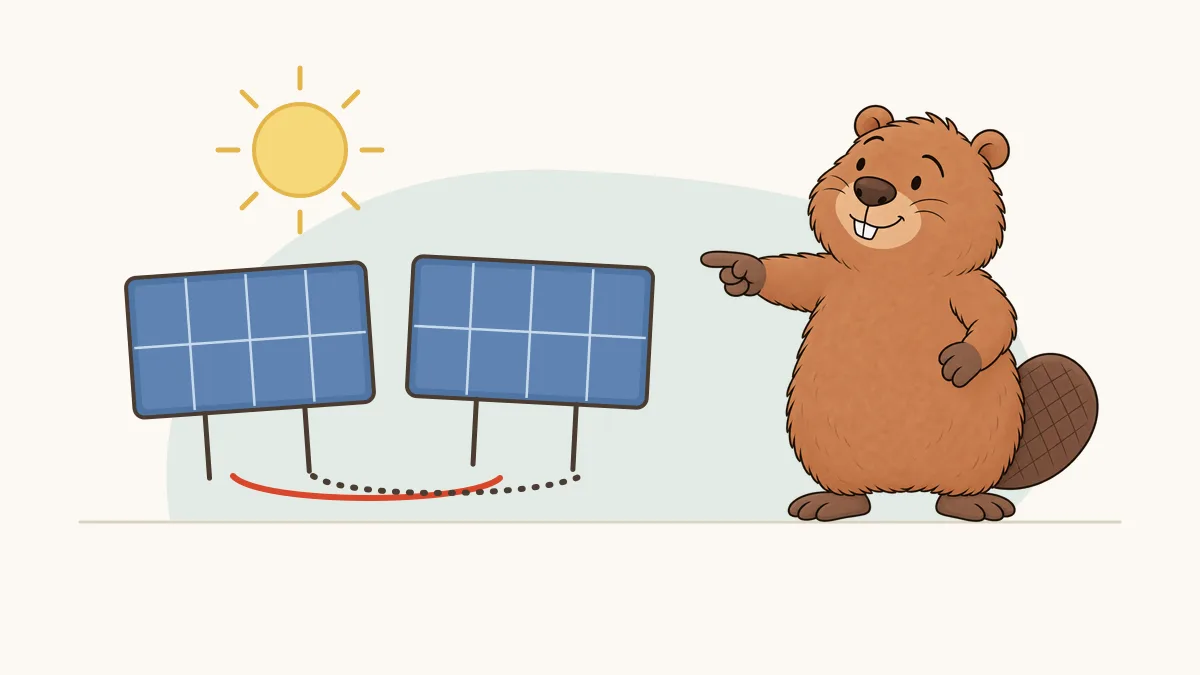
Castor points at two solar panels under the sun, their leads joined positive to positive and negative to negative.

What changes

Two panels in series, two in parallel, four in both

Every number on this page uses the Renogy 100 W (RNG-100D-SS): 22.3 V open-circuit, 18.6 V and 5.38 A at maximum power, 5.86 A short-circuit. Cold figures are for a −25 °C morning.

Series
100 W+−100 W+−MPPT controller

Panel 1's negative to panel 2's positive. Voltages add; the current stays at one panel's.

Open-circuit
44.6 V
Cold (−25 °C)
53.5 V
Short-circuit
5.86 A
At max power
37.2 V · 5.38 A
Parallel
100 W+−100 W+−MPPT controller

Positives together, negatives together. Currents add; the voltage stays at one panel's.

Open-circuit
22.3 V
Cold (−25 °C)
26.8 V
Short-circuit
11.72 A
At max power
18.6 V · 10.76 A
Series-parallel (2S2P)
100 W+−100 W+−100 W+−100 W+−MPPT controller

Two series pairs, joined in parallel. Twice the voltage and twice the current of one panel.

Open-circuit
44.6 V
Cold (−25 °C)
53.5 V
Short-circuit
11.72 A
At max power
37.2 V · 10.76 A

Scroll the table sideways to see both columns.

Series and parallel solar wiring compared
SeriesParallel
VoltageAdds up: two 22.3 V panels give 44.6 VStays at one panel's: 22.3 V
CurrentStays at one panel's: 5.86 A short-circuitAdds up: 11.72 A short-circuit
Cable from the roofLower current, less loss; thinner cable or longer runsTwice the current; thicker cable for the same loss
Shade on one panelDrags the string down until bypass diodes switch the panel outOnly the shaded panel loses output
ControllerNeeds an MPPT controller, and uses up its voltage limitWorks with PWM or MPPT; uses up the current limit
Cold weatherCold Voc multiplies with every panel added: the limit to checkCold Voc stays near one panel's
FusesOne string: no string fuseFrom three strings, usually a fuse per string

Power is the same either way: two 100 W panels make 200 W at the panels whether they are in series or in parallel. What differs is how much of it survives the cable, the shade and the controller.

Pick for the installation

Vans, boats and off-grid cabins

The same rules land differently on a van roof, a sailing boat and a ground-mounted cabin array.

Usually series, or 2S2P

Campervan

A van roof is flat and mostly unshaded, and the controller is often a few metres away, so series keeps the cable thin through the roof gland. Roof vents, a roof box or an air conditioner throwing shadow across one panel is the case for parallel, or for keeping the shaded panel on its own string.

Often parallel

Sailing or motor boat

A mast, boom, rigging and radar cast shadows that move with every tack and every swing at anchor, so series strings spend much of the day held back by one panel. Parallel, or one small controller per panel, keeps the sunny panels working. Series still pays off on a clear arch or a long run to the battery compartment.

Series strings

Off-grid cabin

Ground-mounted arrays can be placed clear of shade, and the run to the battery shed is often tens of metres, so higher voltage and lower current save real copper. Cabins also see the coldest mornings: check the cold Voc at your site's lowest temperature before adding the last panel to a string.

Cold-weather Voc

Check the string's voltage on the coldest morning

A panel's voltage rises as it gets colder. The highest voltage it will ever reach is its open-circuit voltage at sunrise on the coldest day, before the cells warm up, and that is the number that must stay under the controller's maximum PV voltage.

Method 1 · NEC Table 690.7(A)

cold Voc = Voc × panels × factor

NEC Table 690.7(A) factors for cold sites
Lowest expected ambientFactor
−16 to −20 °C (3 to −4 °F)1.18
−21 to −25 °C (−5 to −13 °F)1.20
−26 to −30 °C (−14 to −22 °F)1.21
−31 to −35 °C (−23 to −31 °F)1.23
−36 to −40 °C (−32 to −40 °F)1.25

For crystalline silicon panels when the manufacturer gives no temperature coefficient. The table runs from 1.02 just below 25 °C to 1.25 at −40 °C.

Method 2 · the panel's own coefficient

cold Voc = Voc × (1 + (T − 25) × coefficient)

NEC 690.7(A)(1) prefers the datasheet figure when there is one. This panel's Voc coefficient is −0.28 %/°C, so at −25 °C each panel reaches 25.4 V instead of the table's 26.8 V. The table is the conservative choice; the coefficient is the accurate one.

For T, use the lowest temperature the array will actually see. Installers in the US commonly take the ASHRAE extreme annual minimum for the nearest weather station. A van that winters in the mountains needs the mountains' figure, not home's.

Worked example: how many panels on a 100 V controller?

  • Two in series: 44.6 V on the label, 53.5 V at −25 °C. Fits with room to spare.
  • Three in series: 80.3 V at −25 °C, 83.6 V at −40 °C (1.25). Still under 100 V.
  • Four in series: 89.2 V on the label looks fine, but 107.0 V at −25 °C is over the limit.

So a 100 V controller takes 3 of these panels per string, and a 75 V controller takes 2: three would reach 80.3 V. Over-voltage is the one mistake that can destroy a controller outright, and it happens on a clear, cold morning, often months after installation.

MPPT limits

Three limits on every controller: voltage, current and power

A controller's datasheet gives a maximum PV open-circuit voltage, a maximum PV short-circuit current and a nominal PV power for each battery voltage. Series uses up the first, parallel the second, and every panel uses up the third.

Scroll the table sideways to see every column.

Victron SmartSolar PV input limits and how many 100 W panels fit
ControllerMax PV voltageMax PV short-circuit currentNominal PV power, 12 V100 W panels that fit
Victron SmartSolar 100/20100 V20 A290 WUp to 3 per string, up to 3 strings by current. Two panels in series or parallel; 2S2P (400 W) is more than its 290 W rating.
Victron SmartSolar 100/30100 V35 A440 WUp to 3 per string, up to 5 strings by current. Four panels as 2S2P: 53.5 V cold, 11.7 A.
Victron SmartSolar 100/50100 V60 A700 WUp to 3 per string, up to 10 strings by current. Six panels as 3S2P: 80.3 V cold, 11.7 A.

Voltage headroom helps an MPPT

Victron's controllers need the PV voltage to exceed the battery voltage by 5 V before they start charging, and by 1 V to keep going. Panel voltage falls as the panels heat up in summer sun, so a parallel array of 12 V panels runs with only a few volts in hand; a series string has plenty, and starts earlier on a dull morning.

A PWM controller wants parallel

A PWM controller switches the panels straight onto the battery, which pulls them down to battery voltage. A series string's extra voltage is simply lost, so with PWM wire 12 V panels in parallel, or upgrade to an MPPT controller before going series.

Shade

Why shade favours parallel

In a series string one current flows through every panel, so the string can only carry what its most shaded panel lets through.

In series

A shadow from a roof box, a hatch or a mast on one panel pulls the whole string's current down until that panel's bypass diodes conduct. The diodes then route the current around the shaded cells, and the string loses that section's voltage instead. This panel has two diodes, so each bypasses half the panel.

Two panels in series on a 12 V battery still charge with one panel fully shaded: the sunny panel's 18.6 V stays above the battery. Partial shade is harder, because the controller has to find the best operating point among several.

In parallel

Each panel delivers its own current at the shared voltage. A shaded panel loses its own output and the others carry on, so a moving shadow costs one panel at a time.

Where shade is constant and unavoidable, such as a boom or a radar arch on a boat, a separate controller for the shaded panel isolates it completely: each controller tracks its own panel.

Cable loss

Half the current, a quarter of the loss

Take 6 m of 4 mm² cable from the roof to the controller (each way) and two panels at full sun.

Voltage drop and power lost in a 6 m, 4 mm² PV run
CurrentVoltage dropPower lost in the cable
Series, 37.2 V5.38 A0.28 V (0.8 %)1.5 W
Parallel, 18.6 V10.76 A0.56 V (3.0 %)6.1 W

Same panels, same cable: parallel doubles the current, which doubles the voltage drop in volts and, on half the voltage, quadruples it as a percentage. The watts lost go up four times because loss grows with the square of the current. That is why a long run from a cabin's ground array, or from a boat's arch to the battery compartment, favours series. Copper resistance here is 0.0175 Ω·mm²/m, the figure Crimp's calculators use; check yours with the voltage drop calculator.

Protection

When parallel strings need fuses

If one string shorts, every string in parallel with it pushes current backwards into the fault. A string fuse is needed once that current can exceed the panel's maximum series fuse rating.

Current into a faulted string

(strings − 1) × 1.25 × Isc

Fault current from parallel strings against the panel's 15 A maximum series fuse
StringsFault currentAgainst 15 A
27.33 ANo string fuses needed
314.65 AUnder by only 0.35 A
421.98 AFuse every string

NEC 690.8 counts each string at 125 % of its short-circuit current, for sun brighter than the test standard. Many installers fuse every string from three strings up, whatever the arithmetic says.

Sizing a string fuse

The fuse must be at least 1.25 × 1.25 × Isc, so it does not blow in bright sun: 5.86 A × 1.56 = 9.2 A, so the next size up, 10 A. It must also be no larger than the panel's 15 A maximum series fuse.

Use fuses rated for PV (gPV) at the array's cold open-circuit voltage, in the positive of each string, or a combiner box that holds them. Automotive blade fuses are not rated to break a PV fault.

The battery side is a separate fuse: it protects the cable from the battery to the controller and its size comes from the controller's manual, 25–30 A for a Victron 100/20.
Try it in Crimp

Two 100 W panels in series, sized panel to battery

The series array from this guide on a Victron SmartSolar MPPT 100/20, with a PV isolator and a fused battery cable. Crimp sizes every wire and fuse and checks the cold open-circuit voltage against the controller.

Open the series array in Crimp →

Opens an editable copy of the starting example. Preview changes are not transferred.

Two panels in series wiring diagram: Solar panel 100 W, Solar isolator, Solar charge controller, Battery 100 Ah LiFePO4 and Battery fuse 25 A, with the wire size and fuse marked on each cable.

Live Crimp simulation. Pan and zoom, then select a cable to see its current, size and voltage drop. Open it in Crimp to enter your own lengths.

View full screen

Red = positive · dark = return. Crossings are not junctions. Read the assumptions before adapting a circuit.

Want the other arrangement? Open the parallel array

The drawings, parts list and fuse ratings are on the solar panel wiring diagram. Crimp checks the longest string's cold open-circuit voltage at your site's coldest temperature, set under Vehicle & profile (−25 °C unless you change it), using the panel's temperature coefficient when the catalog has one and NEC Table 690.7 otherwise.

Common questions

Series and parallel questions

Is it better to wire solar panels in series or parallel?

With an MPPT controller, series is usually better when the roof is unshaded or the cable run is long: the current is lower, so less power is lost in the cable. Parallel is better when shade regularly falls on one panel, or when the series string's cold open-circuit voltage would exceed the controller's limit. Four or more panels are often wired as strings of two in series, joined in parallel.

Do solar panels produce more power in series or parallel?

The same at the panels: two 100 W panels make 200 W either way in full sun. The difference is downstream. Series loses less in the cable, parallel loses less when one panel is shaded, and a PWM controller wastes the extra voltage of a series string.

How many solar panels can I put in series?

As many as keep the cold open-circuit voltage under the controller's maximum PV voltage. With 22.3 V panels and NEC Table 690.7's 1.20 factor for −25 °C, a 100 V controller takes three in series (about 80 V); four would reach about 107 V. A 75 V controller takes two.

Do I need fuses for solar panels wired in parallel?

Each string needs a fuse when the current the other strings can feed into a faulted one exceeds the panel's maximum series fuse rating. NEC counts 125 % of Isc per string. With two strings that is rarely possible; with three or more, fuse each string or use a combiner box.

Can I mix different solar panels in series or parallel?

Series strings share one current, so panels in a string should have closely matched current at maximum power; parallel strings share one voltage, so strings in parallel should have closely matched voltage. Mismatched panels on one controller lose output to the weakest match. Different panels are better on separate controllers.

Should I wire panels in series or parallel with a PWM controller?

Parallel. A PWM controller connects the panels to the battery and pulls them down to battery voltage, so the extra voltage of a series string of 12 V panels is simply lost. Series wiring only pays off with an MPPT controller, which converts the higher voltage into charge current.

Is series or parallel better in the shade?

Parallel, usually. In a series string the same current flows through every panel, so a shaded panel drags the string down until its bypass diodes switch it out. In parallel, each panel delivers its own current, and only the shaded panel loses output.